<-
Return back home
Home / SmithPlan

SmithPlan
An academic planner mapping four years into one view
An academic planner mapping four years into one view
ROLE
Product Designer
TEAM
1 Project Manager
1 Software Engineer
DISCIPLINES
Product Design
Design Systems
Prototyping
TIMELINE
6 Months
ROLE
Product Designer
TEAM
1 Project Manager
1 Software Engineer
DISCIPLINES
Product Design
Design Systems
Prototyping
TIMELINE
6 Months
ROLE
Product Designer
TEAM
1 Project Manager
1 Software Engineer
DISCIPLINES
Product Design
Design Systems
Prototyping
TIMELINE
6 Months
Overview
A collaborative planning platform that turns academic chaos into clarity

At Smith College, academic planning is fragmented across Workday, PDFs, spreadsheets, and email threads with advisors. Students can't easily see what they've completed, what's left, or whether they're on track to graduate. SmithPlan unifies requirements, real-time course data, and personalized planning into one shared interface for students and advisors. I led the product design over two years, from initial research through validated prototype.
Problem
The most essential question had no clear answer
Students make high-stakes decisions — which courses to take, when to take them, whether to add a minor — using fragmented, unreliable information. The cost of a mistake isn't just inconvenience. It's an extra semester or a graduation delay.
Planning time without clear info
Planning time with clear info
Smith College Academic Planning Survey, 2023
18%
Complexity
The workaround is inefficient
There is no standard tool for academic planning at Smith. So students build their own.
Some use spreadsheets. Some use Notion. Some use Excel and Google Calendar with color-coded blocks. Some use physical notebooks with hand-drawn grids. Some use nothing at all and rely entirely on memory and their advisor's availability. Every system is invisible to the people who could actually help them.
Learnings
What all these approaches lack
Connection
Disconnected systems force students to identify changes and pass data hand to hand between tools.
Context
Students rely on stale data, leaving them unable to react to changes in their academic plans or course availability.
Visibility
Advisors have no view into the student's plan. Each meeting begins from scratch with no shared understanding.
User Interview
How does it make students and advisors feel?

Overwhelmed
The extra time it takes each week to cross-reference PDFs, update spreadsheets, and email advisors adds up. Students described missing opportunities to explore interests, take creative risks, or simply feel in control of their own education. Many end up making quick decisions with whatever data is available, rather than planning with confidence.

Align on what drive us
How might we create a world where...
Planning ahead is fast and easy to understand?
Students feel confident they have the right information to take action?
Students and advisors effortlessly stay aligned between meetings?
Progress toward graduation is always visible and current?
We distilled our research into shared questions that kept the team aligned through design, prototyping, and testing.
Exploration
The in-between is where planning breaks down
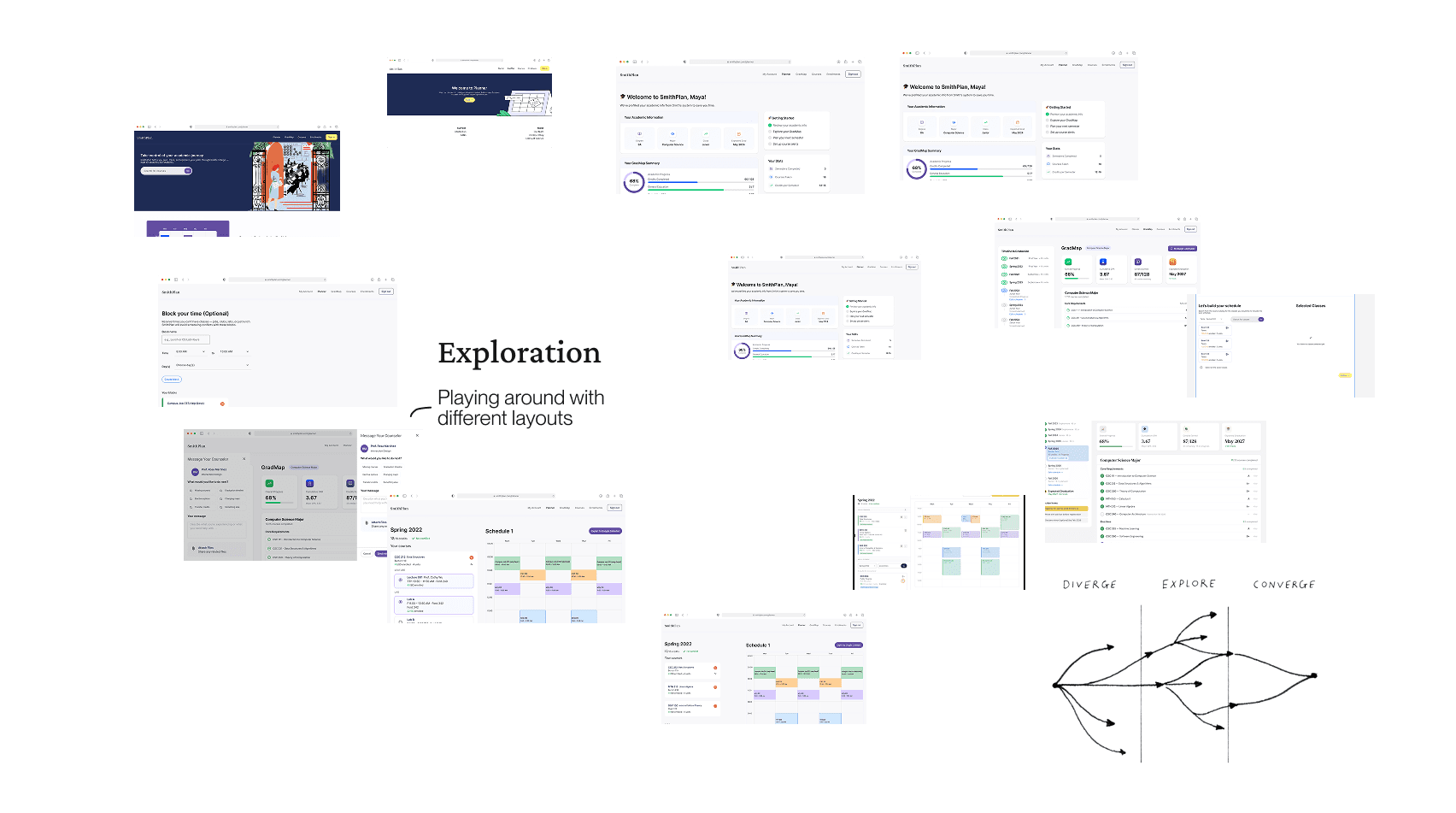
I built quick prototypes to test different approaches with students mid-planning. Each round focused on a different structure for how progress, scheduling, and advising fit together. Testing with real tasks in real moments showed us which patterns clicked and which added confusion.
Solution
SmithPlan — Making progress visible, planning actionable, and advising continuous

SmithPlan unifies requirements, real-time course data, and personalized academic planning into one interface. Students can see exactly what they’ve completed, what’s left, and how each future course affects their path to graduation. Advisors can sign in to review plans, leave guidance, and help students make the right decisions at the right time.
Progress Dashboard
Your academic progress, finally made visual
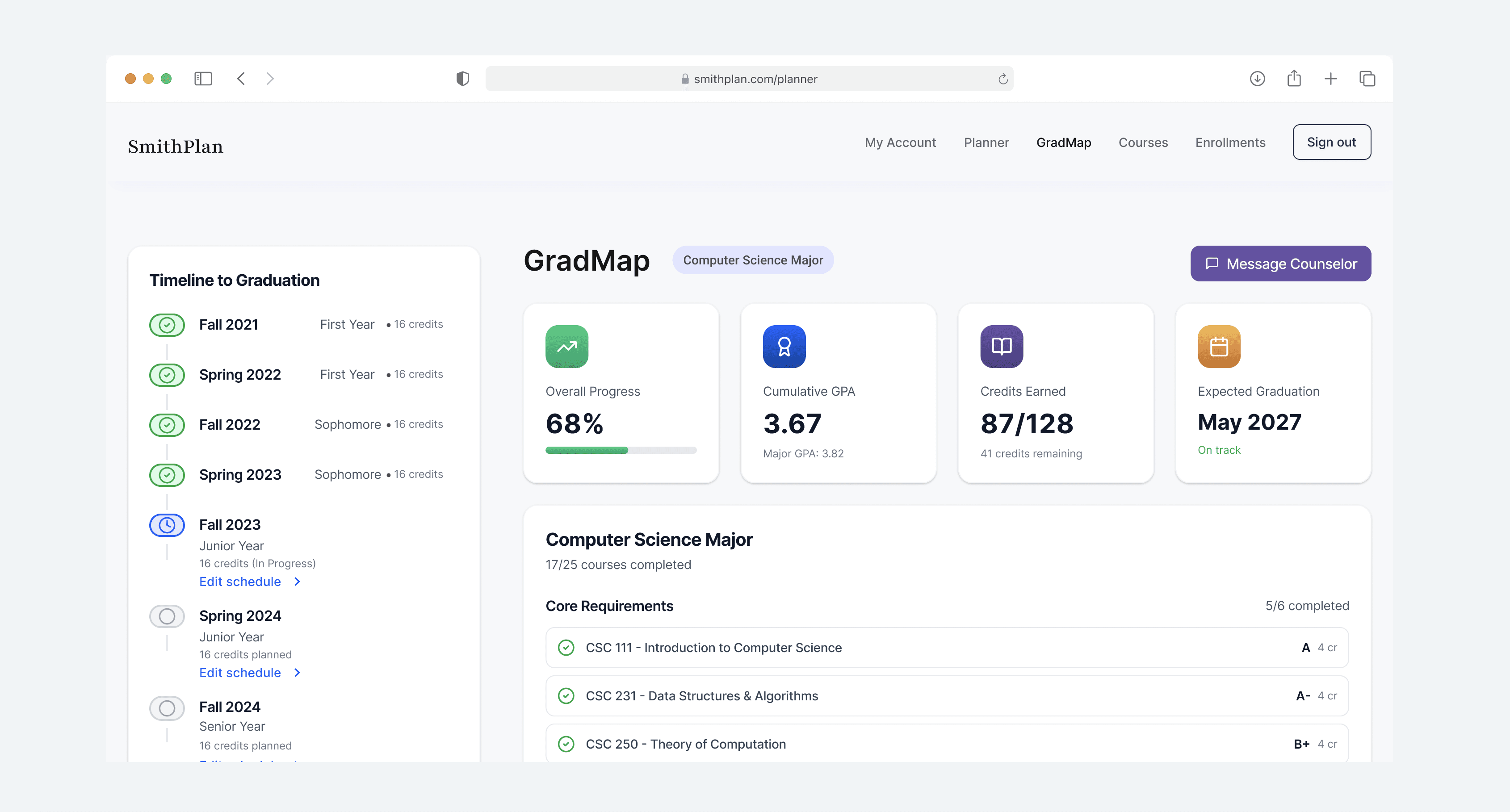
A clear, at-a-glance view of what's completed, what's in progress, and what's still needed. Progress bars for each requirement area, color-coded by status. Students open the app and immediately know where they stand without cross-referencing anything.
Semester Planner
Plan ahead with real-time confidence
Drag courses into future semesters. As each course lands, progress bars update in real time — showing which requirements are satisfied and flagging conflicts before you commit.
Advisor Collaboration
One shared plan, better conversations
Advisors access the same plan the student builds. They review progress, leave annotations, and flag issues — so both parties walk into the next meeting with shared context.
Design System
A system designed for clarity and scaling
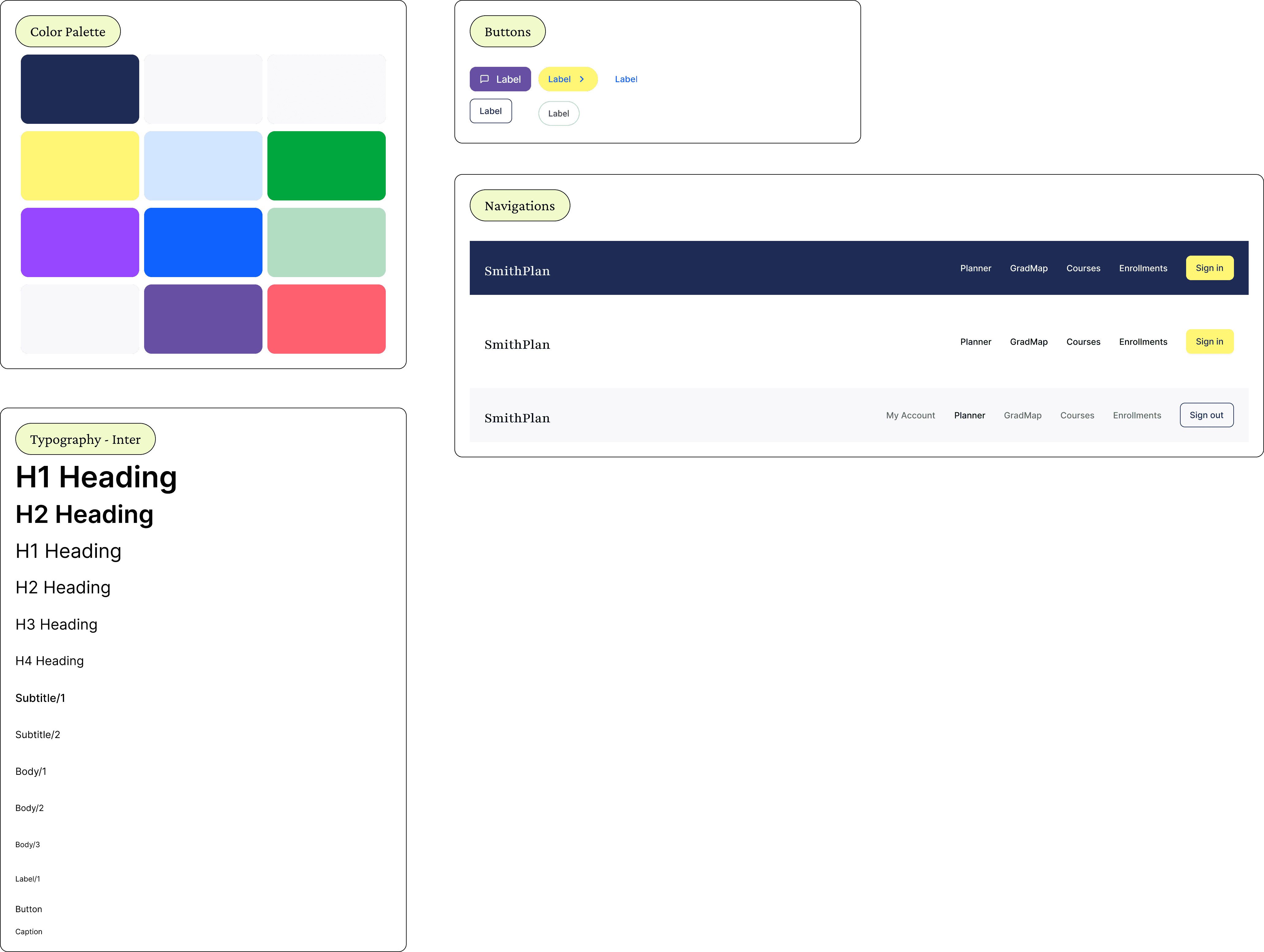
SmithPlan's design system was built around the specific challenge of making dense academic data scannable. Color-coded progress states, consistent typography for requirement categories, and reusable planning components ensure the interface stays clear as the product scales beyond its initial scope.
Impact
Students planned faster and felt confident for the first time
What different did we make?|
Task completion rate
3x
faster than spreadsheet
Confidence
92%
felt on track for the first time
Collaboration
30 mins
eliminated from planning meetings
We tested SmithPlan with students and advisors across multiple rounds. Students completed planning tasks significantly faster than with their existing spreadsheet/PDF workflow. More importantly, they reported feeling confident about their academic plan for the first time.
Overview
A collaborative planning platform that turns academic chaos into clarity
At Smith College, academic planning is fragmented across Workday, PDFs, spreadsheets, and email threads with advisors. Students can't easily see what they've completed, what's left, or whether they're on track to graduate. SmithPlan unifies requirements, real-time course data, and personalized planning into one shared interface for students and advisors. I led the product design over two years, from initial research through validated prototype. SmithPlan was a design proposal for Smith's year-long UX research competition.
Problem
The most essential question had no clear answer
Planning time without clear info
Planning time with clear info
Smith College Academic Planning Survey, 2023
18%
Students make high-stakes decisions — which courses to take, when to take them, whether to add a minor — using fragmented, unreliable information. The cost of a mistake isn't just inconvenience. It's an extra semester or a graduation delay.
Complexity
The workaround is inefficient
There is no standard tool for academic planning at Smith. So students build their own.
Some use spreadsheets. Some use Notion. Some use Excel and Google Calendar with color-coded blocks. Some use physical notebooks with hand-drawn grids. Some use nothing at all and rely entirely on memory and their advisor's availability. Every system is invisible to the people who could actually help them.
Learnings
What all these approaches lack
Connection
Disconnected systems force students to identify changes and pass data hand to hand between tools.
Context
Students rely on stale data, leaving them unable to react to changes in their academic plans or course availability.
Visibility
Advisors have no view into the student's plan. Each meeting begins from scratch with no shared understanding.
User Interview
The emotional cost of planning without a system
Overwhelmed
The extra time it takes each week to cross-reference PDFs, update spreadsheets, and email advisors adds up. Students described missing opportunities to explore interests, take creative risks, or simply feel in control of their own education. Many end up making quick decisions with whatever data is available, rather than planning with confidence.
Align on what drive us
How might we create a world where...
Planning ahead is fast and easy to understand?
Students feel confident they have the right information to take action?
Students and advisors effortlessly stay aligned between meetings?
Progress toward graduation is always visible and current?
We distilled our research into shared questions that kept the team aligned through design, prototyping, and testing.
Exploration
The in-between is where planning breaks down
I built quick prototypes to test different approaches with students mid-planning. Each round focused on a different structure for how progress, scheduling, and advising fit together. Testing with real tasks in real moments showed us which patterns clicked and which added confusion.
We also collected students' data with Workday Student APIs on login to access completed courses, current enrollment, GPA, major, minor, admission year
Solution
SmithPlan — Making progress visible, planning actionable, and advising continuous
SmithPlan unifies requirements, real-time course data, and personalized academic planning into one interface. Students can see exactly what they’ve completed, what’s left, and how each future course affects their path to graduation. Advisors can sign in to review plans, leave guidance, and help students make the right decisions at the right time.
Progress Dashboard
Your academic progress, finally made visual
A clear, at-a-glance view of what's completed, what's in progress, and what's still needed. Progress bars for each requirement area, color-coded by status. Students open the app and immediately know where they stand without cross-referencing anything.
Semester Planner
Plan ahead with real-time confidence
Drag courses to plan out future semesters. As each course lands, progress bars update in real time — showing which requirements are satisfied and flagging conflicts before you commit. We pull the courses from our yearly public list of courses.
Advisor Collaboration
One shared plan, better conversations
Advisors access the same plan the student builds. They review progress, leave annotations, and flag issues — so both parties walk into the next meeting with shared context.
Design System
A system designed for clarity and scaling
SmithPlan's design system was built around the specific challenge of making dense academic data scannable. Color-coded progress states, consistent typography for requirement categories, and reusable planning components ensure the interface stays clear as the product scales beyond its initial scope.
Impact
Students planned faster and felt confident for the first time
What difference did we make?|
Task completion rate
3x
faster than spreadsheet
Confidence
92%
felt on track for the first time
Collaboration
30 mins
eliminated from planning meetings
What difference did we make?|
Task completion rate
3x
faster than spreadsheet
Confidence
92%
felt on track for the first time
Collaboration
30 mins
eliminated from planning meetings
We tested SmithPlan with students and advisors across multiple rounds. Students completed planning tasks significantly faster than with their existing spreadsheet/PDF workflow. More importantly, they reported feeling confident about their academic plan for the first time.