<-
Return back home
Home / Rocky AI
Rocky AI
An AI assistant that knows you're frustrated before you do
Overview
Designing an AI support assistant for Plymouth Rock's mobile app

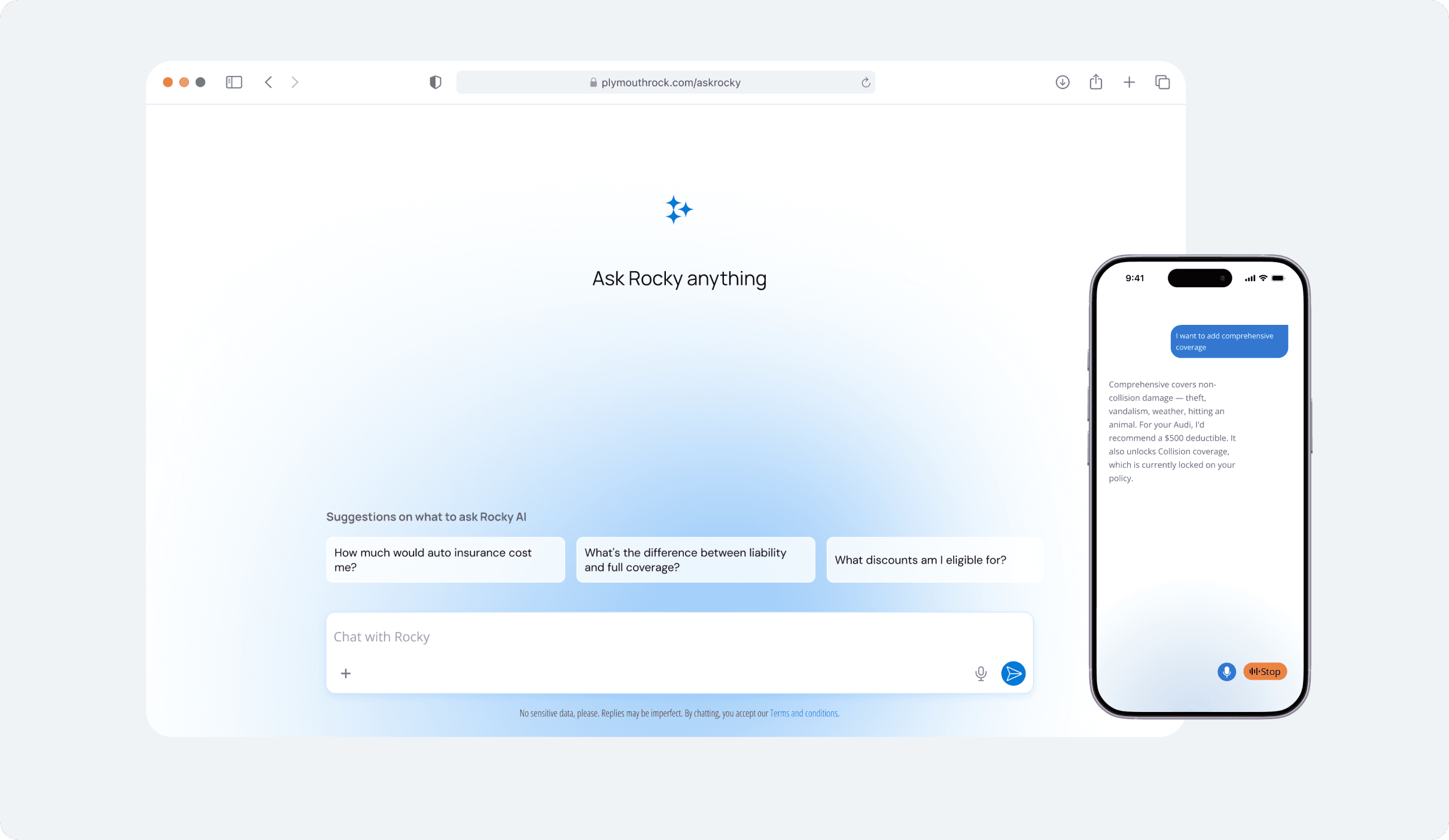
Plymouth Rock's mobile app handles payments, policy changes, and document access. When customers hit friction, their only option is to call. Rocky is a contextual support layer that detects confusion in real time and offers help — through chat, proactive prompts, and voice guidance — before the customer ever picks up the phone.
I led conversational flows, behavioral trigger logic, and escalation patterns from concept through validated prototype.
Problem
Most support calls started from three in-app moments
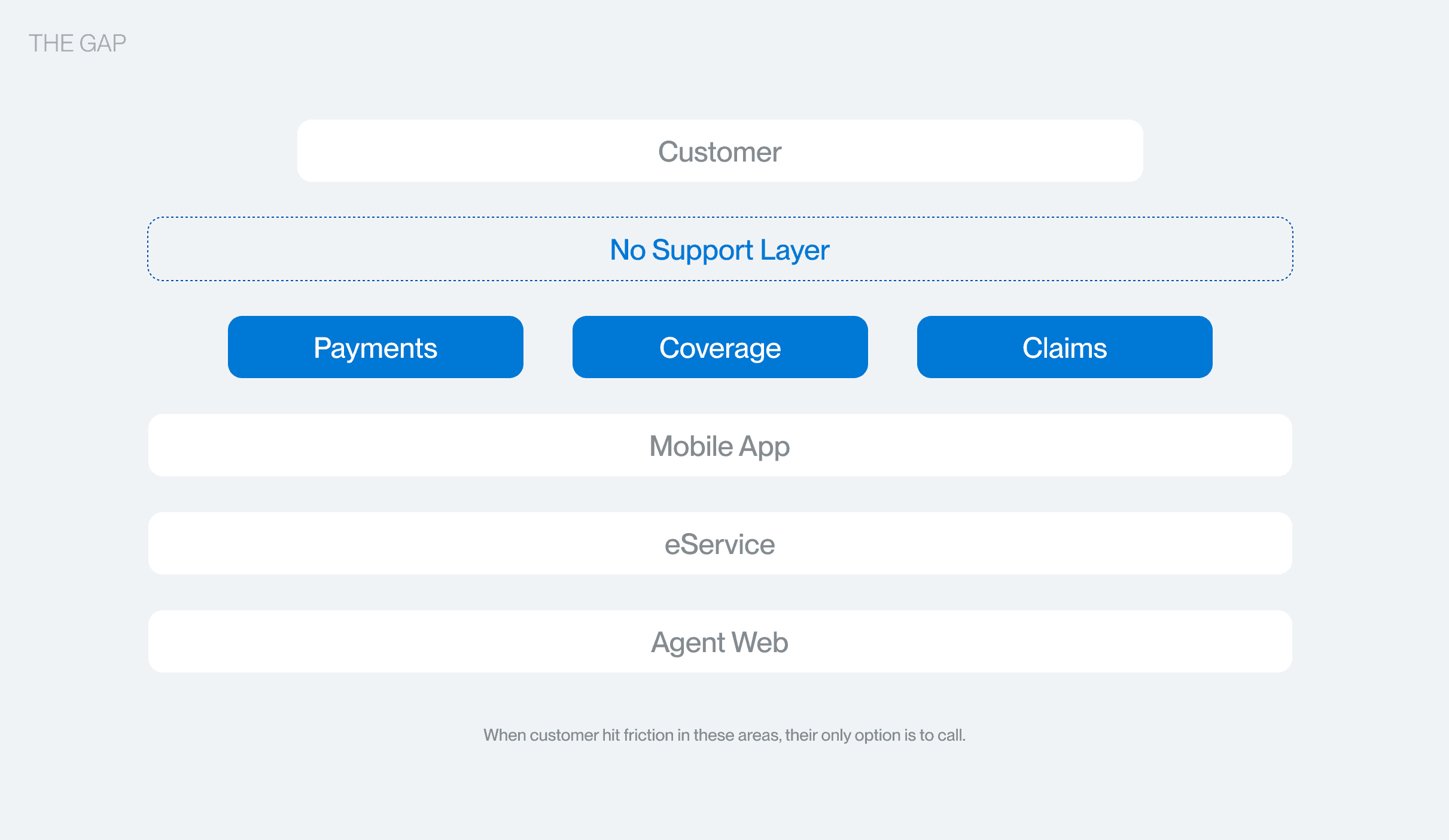
We noticed a high volume of our support calls are driven by in-app frictions. By addressing this, we could not only save the business their annual support cost but also improve app retention.
We reviewed support transcripts, session recordings, and app analytics. The same friction points kept surfacing: failed payments that gave no clear error explanation, endorsement flows where coverage language confused customers, and claim process overwhelmed already stressed out users.
Insight
Customers weren't calling because they had complex questions. They were calling because they got stuck on simple tasks
Session recordings showed the same pattern: a customer would attempt a payment, hit an error, retry two or three times, pause, then leave the app and call. The questions they asked support agents were straightforward. "Why didn't my payment go through?" "What does this coverage term mean?" "Where can I file a claim?". These were all answerable in-app — if the app knew when to step in.
What if the app could detect that moment of hesitation and step in before the customer ever leaves?
Research
Researching the AI chatbot landscape and current apps on the market
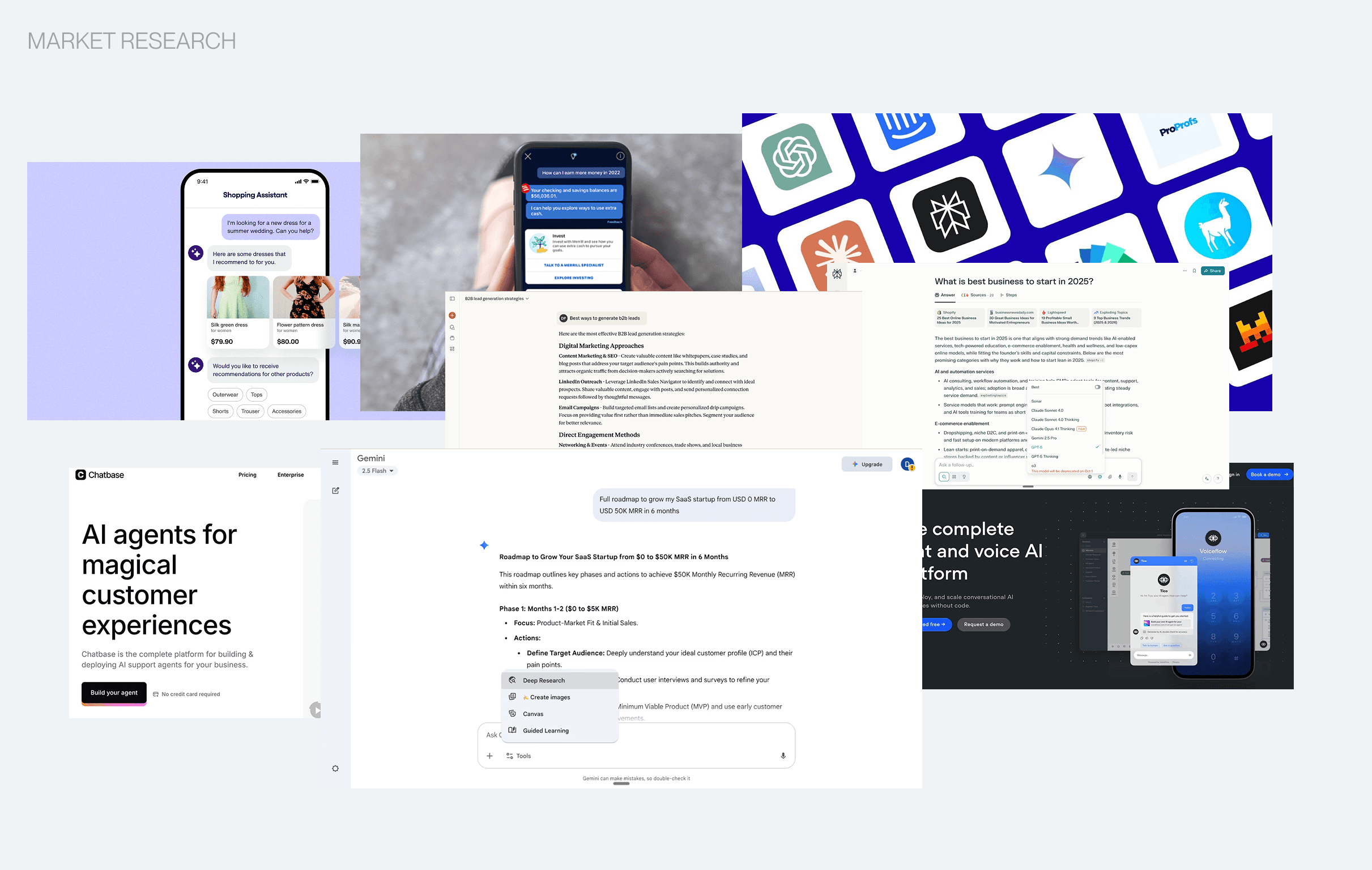
We studied the consumer AI landscape — OpenAI, existing chatbot products, voice assistants, and agent frameworks — to understand what was working and where the gaps were.
Opportunity
In-app support isn't a nice-to-have. It's how customers decide whether to stay
Mobile is becoming the primary way people manage their insurance, and in-app support shapes how they feel about their insurer. By offering seamless chat exactly when customers need help, Plymouth Rock strengthens relationships, reduces friction, and delivers a modern service experience that keeps them with us.
Experimenting with Support Signals
Three constraints that shaped every decision
Guide, not act
Rocky explains options but never changes your policy without explicit consent.
Stay contextual
Every response references the screen you're on, the policy you're viewing, and the specific issue you're facing.
Know its limits
When Rocky isn't confident, it connects you to a live agent with full session context — no dead ends.
We explored different ways to show when the app should step in — from progress indicators to gentle prompts to fully proactive alerts. But insurance isn’t linear, and no single signal worked for every situation. We needed something more adaptive and context-aware.
Alignment
Define success
Customers resolve common support questions in-app without calling an agent
Rocky surfaces help only when confusion is genuine — not during normal browsing
When Rocky can't help, it hands off to a live agent with full session context — no cold transfers
We aligned early on what Rocky needed to achieve to justify further investment. These metrics gave us a shared bar across design, engineering, and customer service — something to pressure-test every decision against. We also wanted to focus on the metrics like numbers of support call, drop off rates after error, trust and confidence.
Strategic Directions
We explored three directions for in-app support
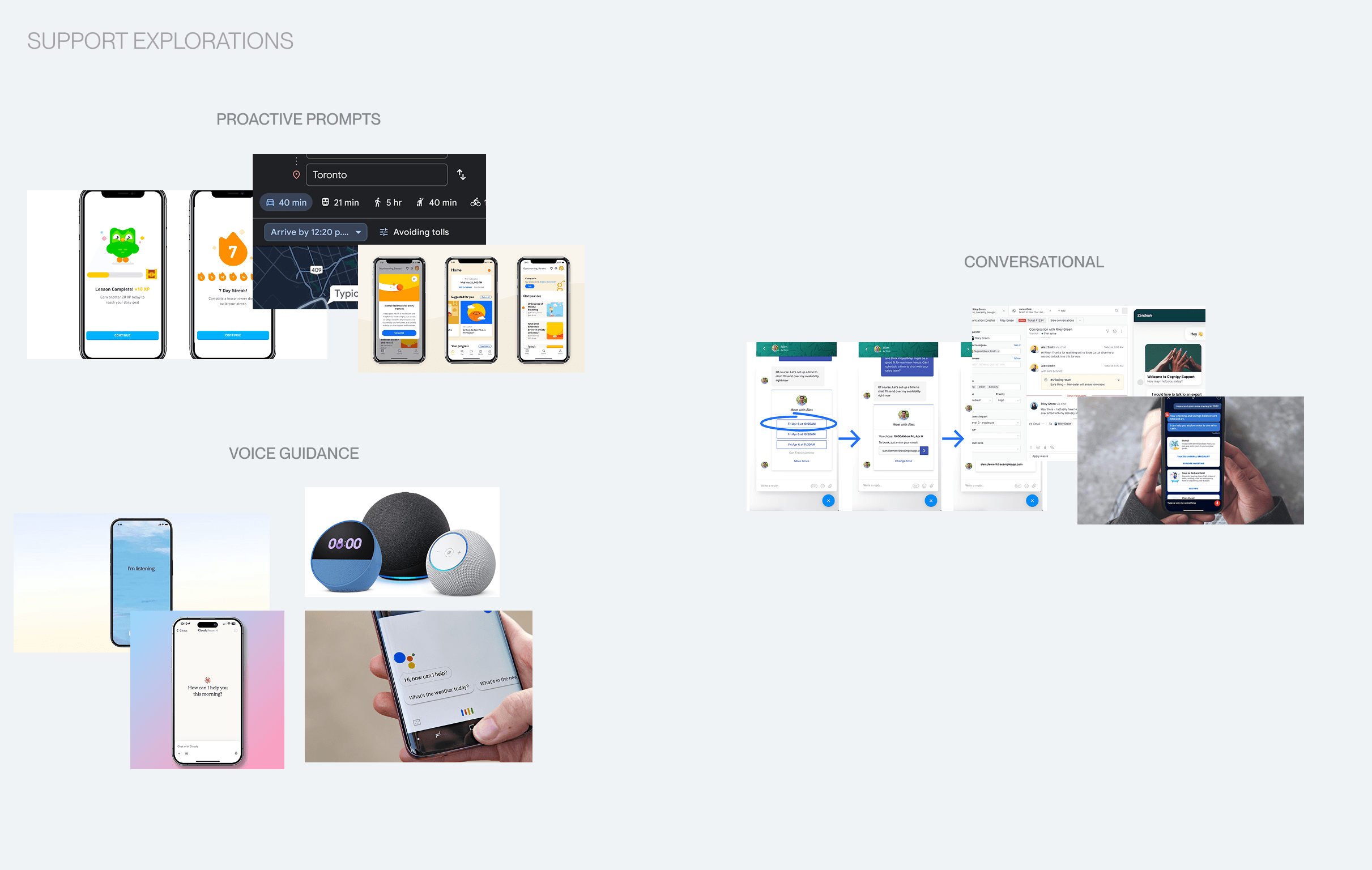
We explored product direction and interaction model, and designed for an experience that would show customers how Rocky works and the immediate value of contextual assistance.
Testing and Prototyping
We explored a range of support concepts — here are a few of them
Before landing on the proactive assistant model, we prototyped several different approaches to in-app support. Each taught us something about what customers actually need in the moment.
Prompt Surface Explorations
Toast was too easy to miss. Overlay card got attention without feeling intrusive.
Contextual Education
Inline tooltips worked only when explanations referenced the user's policy, not generic definitions.
Voice Interaction Models
Overlay for simple questions. Full-screen for multi-step guided flows.
Design Decisions
We mapped how Rocky fits into the existing app architecture
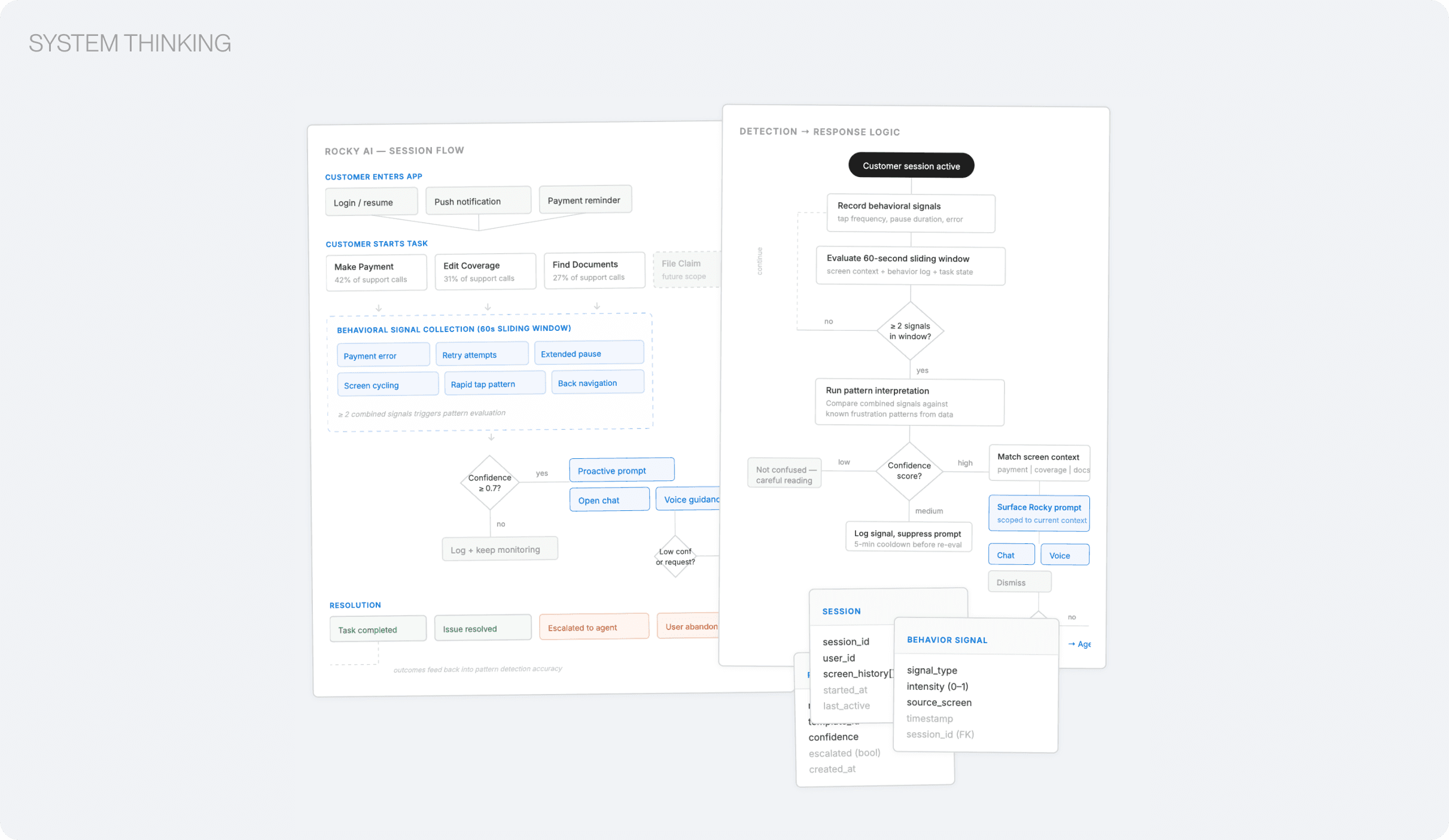
With insights from research and trigger logic exploration, we mapped how a contextual AI layer integrates with the existing mobile app — what data it reads, what it can surface, and where human handoff occurs.
Solution
Introducing Rocky AI
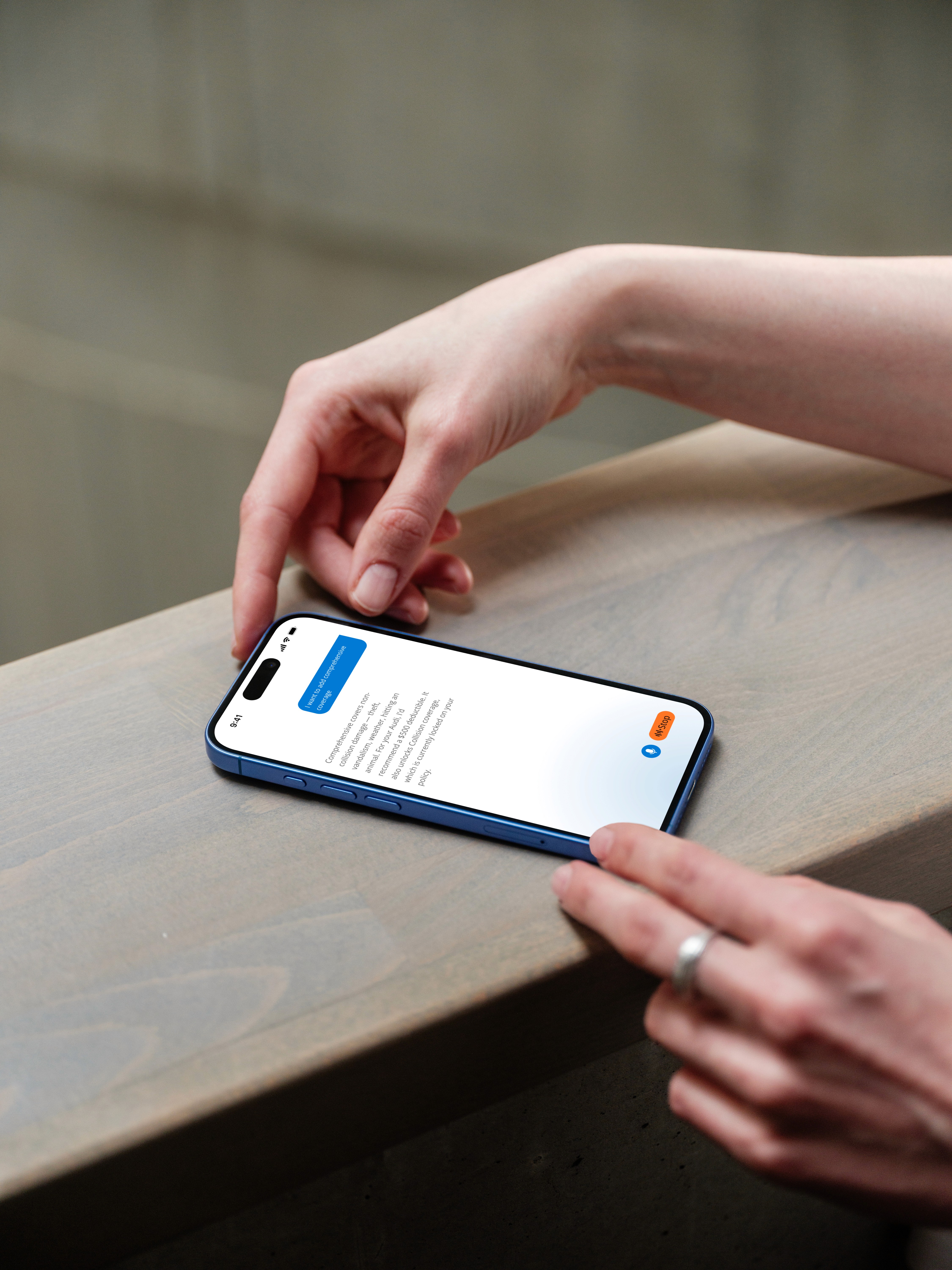
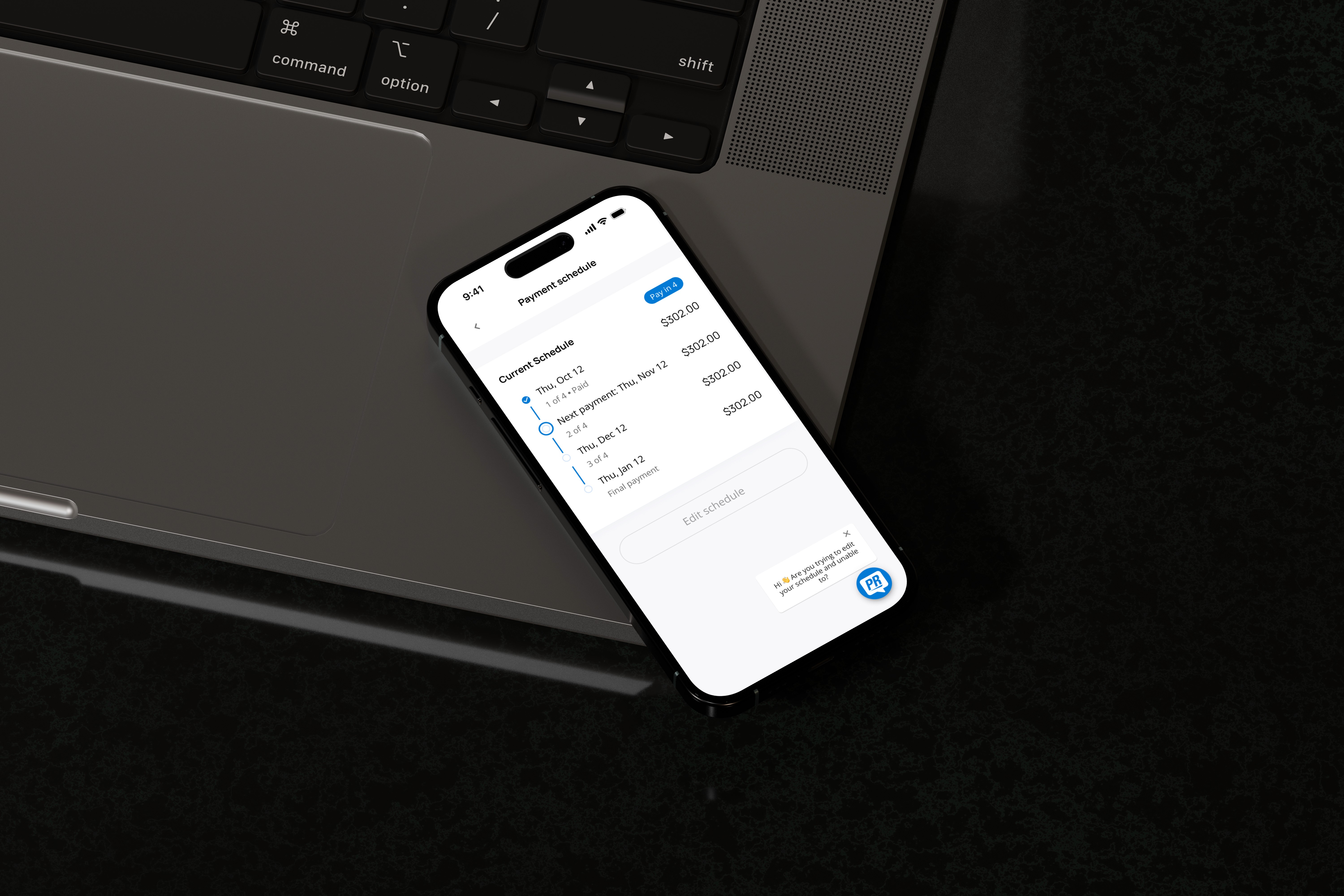
Smart Assistance
The app notices when you're stuck and offers help before you ask
If the system detects repeated errors, rapid tapping, long pauses, or bouncing between the same screens, the chat widget surfaces with a simple "Need a hand?" — real-time help exactly when frustration peaks.
Live Chat
Fast, context-aware answers scoped to the current session
The chat knows which screen you're on, what policy you're viewing, and what action you were trying to complete. Responses reference your specific situation, not generic FAQs.
Voice Mode
Voice guidance for tasks where reading instructions adds friction
For multi-step tasks like endorsement changes, voice walks through each screen and explains why a step matters for the customer's coverage — not just what to tap.
Education
Simplify insurance for everyone
Insurance is full of jargon. Rocky offers resources and articles for when users are curious and want to know more about certain topics.
Design Decisions
We scoped aggressively for v1 — and that was the right call
We explored several directions with product, engineering, and service teams. Full conversational AI and autonomous task completion were considered but deprioritized — latency, error risk, and integration complexity made them impractical for a first release.
The proactive assistant emerged as the most viable path: lightweight, contextual, low-latency, and integrable without architectural overhaul.
Impact
Lower support cost, faster task completion and higher resolution confidence
What did we prove?|
Task completion rate
73%
resolve in-app without calling support
Resolution time
4x
faster than average call
Support call volume
285 calls/mo
deflected from the support team
Trigger precision
88%
accurate detection of genuine confusion vs careful reading
Currently in beta testing with 2.4K users, covering failed payments, endorsements, and document retrieval. Pattern-based triggers dramatically reduced false positives compared to the rule-based approach.